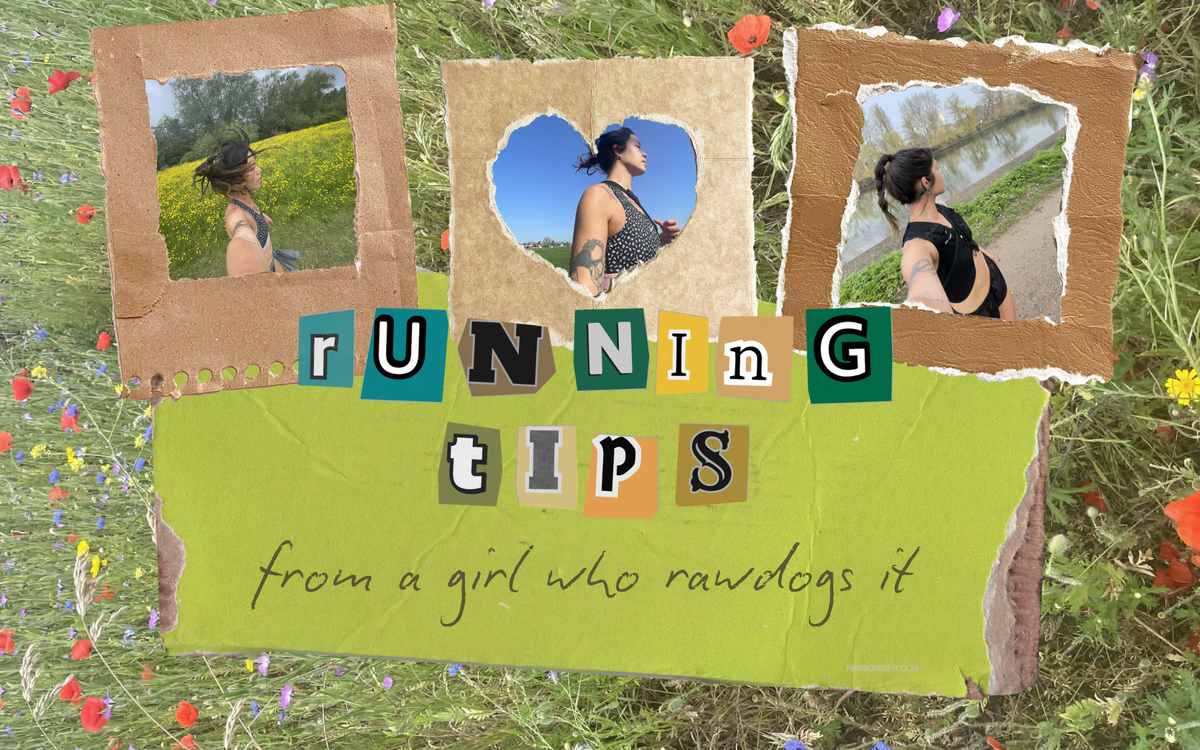
Running Tips From a Girl Who Rawdogs It

I started running (as most people did) in the height of Covid. I knew I needed to shift some weight but I had no idea where to start. I was awful at first: I think my first run was 1.5km where I walked most of it.
Over the next few years, I picked it up and dropped off more times than I can count, rarely managing to get past 5km (shoutout to Couch to 5K, you’re a real one and I highly suggest that as a starting point). Eventually, through a mix of perseverance and sheer willpower, I cracked 5km in 2023. From there on it’s been exponential progress.
The beauty of running is the low barrier to entry. If you’re new to working out or simply want to have a healthy hobby, it might seem a little intimidating to start. Running and many other sports are increasingly gentrified, social media makes it feel like you need a full Salomon kit and the freshest Hokas to start. But I’m here to tell you that you don’t: all you need is some trainers and determination.
I know the internet loves to clown on how many people are into running now, but honestly? More people doing something genuinely good for themselves is not a bad thing! What I don’t love is the noise - the endless fads, the bullshit techniques and TikTok advice that makes running seem more complicated than it needs to be. (Also what I don’t love, is that now so many people are into running I’ve still not gotten a coveted ballot spot for the London Marathon three years in a row now).
I’m chaotic in how I approach running. Training plan? Don’t know her. I still haven’t fully quit smoking, and I have no idea what the benefits of carbon plated shoes are. But I do have some mileage behind me: I’ve completed four ultramarathons, I aim for 20-30km a week, and a 10-miler on a Saturday morning is truly a treat. So I like to think I know what I’m talking about - mostly.
Here’s some random and non-sensical tips from an extremely dedicated but not disciplined runner.
- Have a good playlist
A good playlist can change everything. Make sure it’s long and varied (so you can skip through with endless abandon) but most importantly, full of whatever tunes gets your blood pumping and the vibes FLOWING. I used to make one every year, but I’ve peaked with my ‘ULTIMATE RUNNING MIX’ (linked for your convenience) which is a mix of high BPM, DnB remixes of pop songs, the occasional hardstyle and techno tunes as well as random sprinklings of heavier stuff like Kneecap and Electric Callboi.
The importance for me is lyrics: in harder parts of runs, focusing in on the words helps me block out the I can't do this voices when I’m in the pain cave. A good stretch of road or nature with an absolute banger will get your split time down. I’ve had to rawdog a few races or had my headphones die on the last part of runs and let me tell you: you better be comfortable with your inner monologue.
- Fuelling properly
It might sound obvious, but to me it wasn’t! As someone who started running to lose weight, I feared carbs with every fibre of my being and was permanently in a calorie deficit. I had some unhealthy behaviours (eating 900-1200 calories a day at times), and often found myself dragging my feet or on the brink of fainting at the end of particularly gruelling runs.
Eating before a run isn’t for everyone. For shorter distances like 5-10k, I don’t think it’s essential. But things changed when I saw the difference with my half marathon times.
In May 2024, I ran an official half in 2:09:46. The night before, I’d eaten an 18-inch pizza, and on race morning I had two Red Bulls. My splits fell apart after the 16km mark, and by the end I was struggling.
Fast forward to May 2026 - I ran another half for shits and giggles, and finished in 1:54:45. My pacing was consistent throughout, and that was with traffic lights and weaving through pedestrians. A big part of that improvement came from actually fuelling my body properly instead of depriving it. (And yes, a year of consistent running helped - although ngl I definitely fell off training in 2025, my depression era)
If you are eating beforehand, give yourself time to digest - at least an hour for a bigger meal. For anything over 10km, my go-tos are banana and oat smoothies, overnight oats, or eggs on toast if I'm feeling brave. Carbs are not the enemy!!
As for fuelling during a run, it’s completely personal. Some people swear by sweets, others by gels, some say gels make them shit themselves. I lean towards gels - mostly because I’m terrified of choking and dying mid-run (what a hardcore way to go out tho. Death is temporary but Strava is forever).
Ultimately, it’s about finding what works for you.
- Get your gait checked
I’d say this is the point where running starts to get serious. Until you’re fully committed - and willing to drop £100+ - just stick with whatever trainers you already have. This is where running can get expensive.
I held out for a while, running in a beat-up pair of Nike trainers I’d picked up for £30 in Decathlon on holiday, the obligatory ‘in case of sporty emergency shoes’. Eventually, I took the plunge and got my gait analysed at a running shop. After a short treadmill run and a quick video assessment, they pinpointed what was holding me back.
It turned out I was overpronating, rolling my feet inward and putting extra strain on my big toe and tendons, which explained the constant shin splints and knee pain. I needed stability shoes to correct it, along with proper shock absorption for road running.
I really wanted to love the trendier options they suggested - Hokas, ASICS - but the moment I tried on those Saucony Omni 22s, I had my Cinderella moment. My speed and endurance improved almost immediately, and on my first run in them, I genuinely felt like I was flying.
Once you find your shoe, stick with it. And if you can grab a pair (or two) in a sale, even better - at £160 a pop, it’s worth setting alerts. Just don’t hang onto them for too long: aim to retire your shoes around the 500–700km mark, or when you start noticing those familiar aches creeping back in.
- Focus on distance, not speed
I avoided Strava for the longest time, purely out of shame about how slow I was. But the truth is, all paces are valid. I’m still guilty of beating myself up every time I don’t set a new PB, but I constantly have to remind myself: just being out there, putting myself through it in the first place, is enough.
I like to think of it as finished but not perfect. Focus on running your goal distance comfortably, and everything else will follow. Once that distance feels natural, everything starts to fall into place, and eventually it becomes muscle memory.
- Run in winter
I’ve run in every kind of weather: -5 degrees, torrential rain, 35-plus heat, even snow. I know I’m a masochist when I’m out running in booty shorts, the winter sun has not risen yet and I can see my breath.
These are the runs where I genuinely question my sanity, just how far I’ll go to commit to the bit. Everything feels hostile, the conditions are against you and with every step I’m negotiating with myself. But those are the runs that build resilience and further hammer in the discipline.
Then spring arrives. There’s sun on my face, a light breeze on my back, I’m not freezing my titatas off in the first five minutes, and suddenly all those brutal winter miles were worth all the anguish. Progress doesn’t come from comfort - it comes from showing up when you really don’t want to. The only run you regret is the one you didn’t do.
- Run with friends
For the most part, I’m a solitary runner. I love the quiet, the way I can think about nothing and everything all at once. It’s the closest thing I have to meditation, the only time I can properly switch off.
Run clubs are my worst nightmare (but if that’s what gets you out the door, go for it). That said, running with friends has made a real difference. My running partner has pushed my speed and endurance, helping me reach new distances as we champion each other during particularly hard races.
I also run regularly with colleagues on our lunch break. Those runs aren’t about chasing PBs - they’re slower, easier and a nice way to bond outside of the office. And apparently, you’re meant to be able to hold a conversation in Zone 2. Not that I take any TikTok running advice as gospel.
- Run the wrong way
If you don’t have a set route, one of my favourite strategies is to head off in a completely random direction until you hit the halfway mark. It forces you to run back - unless you fancy being stranded somewhere unfamiliar (I have found myself in lost in the backrooms of suburbia, industrial estates and once, at Big Ben by accident, after running from my mate’s place in Stockwell).
Over time, you’ll naturally find routes that work for you. Plus, I’ve stumbled across some genuinely great spots just by getting myself intentionally lost. (Pro-tip for if you’ve just moved into a new area, it’s a great way to get to know your neighbourhood).
- Don’t worry about being perceived
When you see someone running down the street, what do you think? I don’t think you give it a second thought at all, right? If I do, it’s usually something along the lines of good for them whilst wondering what distance they’re covering. I’d go as far as to say, anyone who passes you in the street is probably thinking of something similar.
The fear of being perceived whilst in a vulnerable state - sweaty, out of breath, and very much Not Having A Good Time™ puts a lot of people off. But the reality is, no one is giving you a second thought. And even if they are, you’ll likely never see them again. You’ll be long gone cuz you’re Speedy Gonzales.
(Though I have on several occasions bumped into my gym crush whilst on a run, red faced and losing my will to live. Fuck my silly little life).
- Your body will carry you through on the day
Maybe I’m too proud that I don’t ever follow a training plan for races. I’m a big believer in you know your body best. Everyone has varying schedules and priorities - not everyone has the luxury of being able to focus on training when juggling various responsibilities.
It fascinated but didn’t shock me that the average salary of an amateur Iron Man triathlon finisher was $250k. I mean, people living paycheque to paycheque likely do not have the same free time to train as someone on six figures.
I’ve done four ultramarathons (and successfully finished one), never training the full distance beforehand - usually just 50–75% of it. If you have the time to train more, great. Don’t feel bad if you can’t dedicate more time to it. Consistency matters more. Keep showing up, keep pushing your limits, whether that’s speed or distance - the rest of it is a mental game. Your body will carry you through on the day, and you’ll always amaze yourself.
- Have gratitude
It might be cheesy, but don’t forget to be grateful for your body. It’s easy to take it all for granted. I often find myself expressing thanks to my body as I carve out new distances and when the going gets tough.
I am grateful for my legs, my strong legs that can take me through some crazy distances. I’m grateful for my stamina, my strength, the determination I have to get through it.
It’s easy to forget that not everyone is able-bodied or has the privilege to push their bodies to the extreme. Be thankful for it. Practise gratitude on your runs, particularly when it gets hard.